


Lot n° 302
Estimation :
4000 - 6000
EUR
Register for the sale on drouot.com
Leave absentee bid
Your amount
EUR
Bid by phone
Bid by phone
Your amount
EUR
GUY DE ROUGEMONT (1935–2021) - Lot 302
GUY DE ROUGEMONT (1935–2021)
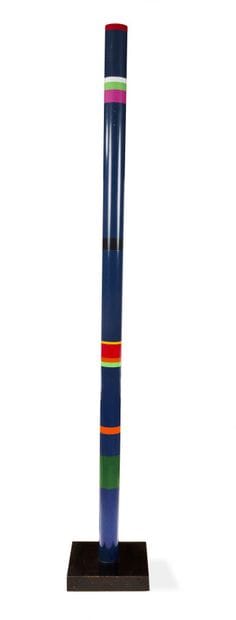
“Column; Very Large Format,” also known as “Totem; Very Large Format”
also known as “Cylinder; Very Large Format,” circa 1972–1975
Painted PVC; base made of particleboard covered with melamine.
H.: 237 cm - Base: 35.5 x 35.5 cm.
Provenance: Mrs. X’s Collection; Gironde.
Bibliography:
- Renée Beslon, Marie-Odile Briot, and Françoise Thieck—Rougemont 1955/1972—A book published on the occasion of the exhibition organized by the Galerie du Luxembourg in Paris in 1973, Baudard-Alvarez, Paris, 1973. The “Colonnes” are reproduced on pages 46, 50–53, and 57–60.
- Bernard Lamarche-Vadel - Rougemont - A book published on the occasion of the exhibition organized by the Galerie du Luxembourg in Paris in 1974, published by Baudard-Alvarez, Paris, 1974. Reproductions of the “Colonnes” on pages 24–25, 27, 28, 30, 32–33, 34–35, 36–37, 42–43, 44–45, 47–49, 50–51, 53, 54–55, 58–59, 61, 69, 73, 74–75, and 76–77.
- Various Artists - Rougemont; Public Works and Decorative Arts 1965–1990 - A book published on the occasion of the exhibition held at the Musée des Arts Décoratifs in 1990, published by Union des Arts Décoratifs, Paris, 1974. Reproductions of “Colonnes” on pages 48, 63, 68, and 73.
- Xavier Bordes - Rougemont; Imperishable Traces of Light - A book published on the occasion of the exhibition organized by the Galerie Pascal Gabert in Paris in 1992. The “Columns” are reproduced in this book without page numbers.
Guy de Rougemont (1935–2021)
A quintessentially multidisciplinary artist, Guy de Rougemont considered himself first and foremost a painter. His unique pictorial universe extended into numerous artistic fields, in keeping with his quest to break down the barriers between the arts. This “playful geometer” thus created a body of work of great visual variety, marked by color, at the intersection of painting, sculpture, the decorative arts, and architecture.
Influenced by Pop Art and American Minimalism of the 1960s, his work borrows their vivid colors, streamlined forms, and the use of acrylic paint on large-scale canvases. The year he spent in New York in 1965 certainly reinforced his interest in these movements—especially since he met major figures there such as Andy Warhol and Robert Indiana. His paintings from that period feature flat areas of color and simplified geometric shapes—particularly the ellipse.
In the early 1970s, however, Guy de Rougemont shifted his focus to cylinders and tubular forms, which he rendered in his signature polychromatic style. By combining curves and straight lines, the cylinder opened up new avenues for artistic exploration. Through his commissions—both private and public—he combined these forms in various sizes, sometimes monumental, and covered them with geometric patterns and vivid, highly recognizable colors. Part tube, part column, the cylinder fits perfectly within the realms of modernity, architecture, and space—which he seeks to explore. Standing alone, it also echoes traditional totems and their symbolic and sacred power—as the title of our work makes abundantly clear.
My orders
Sale information
Sales conditions
Return to catalogue